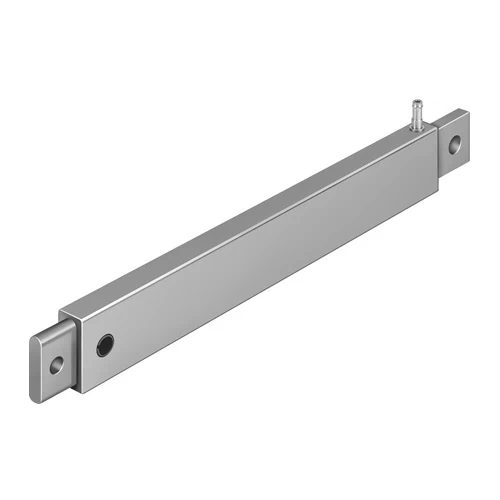
1. Small Component Ejection
An assembly nest needs a small released component pushed clear before accepting the next part. The 25 mm pushing stroke provides the actuator travel, with 52 N theoretical advance force specified at 6 bar. Spring return retracts the mechanism after the pneumatic command is removed, while the rectangular rod defines the documented moving interface for the pusher arrangement.
Problem Solved
A powered pushing stroke followed by spring return supplies the eject-and-retract movement, giving the fixture a compact actuator with documented stroke and theoretical advance force.
25 mm stroke
52 N at 6 bar
Spring return
2. Maintaining a Small Contact Tool Orientation
A small fixture contact needs to maintain its orientation as it advances toward a workpiece. The EZH uses a rectangular piston rod, explicitly listed by the manufacturer as its protection against torque and guide arrangement. Its single-acting 25 mm stroke supplies the approach movement, while cross-bore mounting supports installation of the 108 g cylinder within the fixture structure.
Problem Solved
The rectangular rod addresses unwanted turning of the moving contact during travel, preserving its orientation through the cylinder arrangement without assigning an unsupported numerical torque capacity.
Rectangular rod
Cross-bore mounting
108 g
3. Spring-Returned Process Stop
A compact mechanism moves a small process stop into position when compressed air is applied and withdraws it through the cylinder spring after the command. The selected unit has a 25 mm stroke and theoretical spring return force from 8 to 10.6 N. Its PK-3 barbed connection and 2.5–6 bar operating range define the pneumatic interface for that local stop mechanism.
Problem Solved
The spring provides a defined mechanical return action after the pushing command, allowing the small stop to withdraw without a second pneumatically powered cylinder chamber.
Single-acting
8–10.6 N spring return
PK-3 connection