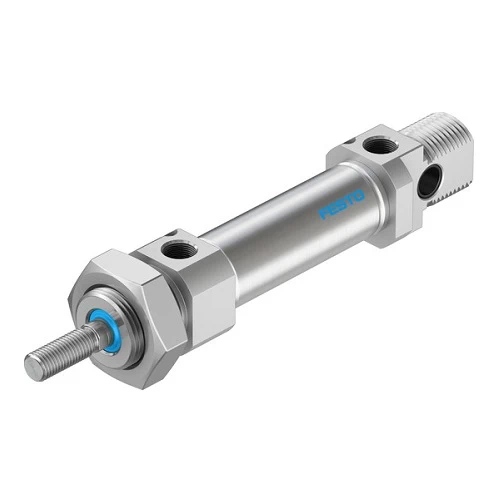
1. Linear Part-Ejection Mechanism
An assembly machine ejects a completed part from a fixture through a short linear movement. The cylinder supplies a 25 mm double-acting stroke, with the M8 rod thread connecting to the ejector mechanism. Adjustable cushioning at both ends supports setting the end approach, while proximity switches can provide the machine sequence with cylinder-position signals.
Problem Solved
A defined powered stroke and return movement support repeatable ejector sequencing, with threaded attachment and proximity-switch detection linking the cylinder to the surrounding mechanism and controls.
25 mm stroke
Double acting
M8 rod thread
2. Pneumatic Clamp Movement in an Assembly Fixture
A workstation moves a mechanical clamp into and out of position during part loading. The cylinder provides 188.5 N theoretical advancing force and 158.3 N theoretical return force at 6 bar, giving the builder a documented actuator-force basis for the clamp linkage. Its double-acting operation powers both movements, while G1/8 ports connect the fixture's directional-control circuit.
Problem Solved
Published theoretical forces and powered motion in both directions support sizing a pneumatic clamp linkage, rather than assuming the same force is available on advance and return.
188.5 N theoretical advance
158.3 N theoretical return
G1/8
3. ISO-Format Conveyor Diverter Actuation
A conveyor installation uses a linkage to move a diverter between product routes. The ISO 6432 cylinder provides an established cylinder format, a 25 mm stroke and adjustable pneumatic end cushioning. Accessory mounting connects it to the machine structure, and proximity-switch position detection can indicate completion of each movement to the conveyor sequence.
Problem Solved
The ISO cylinder format supports mechanical integration while adjustable cushioning and position-detection provision help coordinate the diverter's end movements with the conveyor control sequence.
ISO 6432
Adjustable cushioning
Position detection