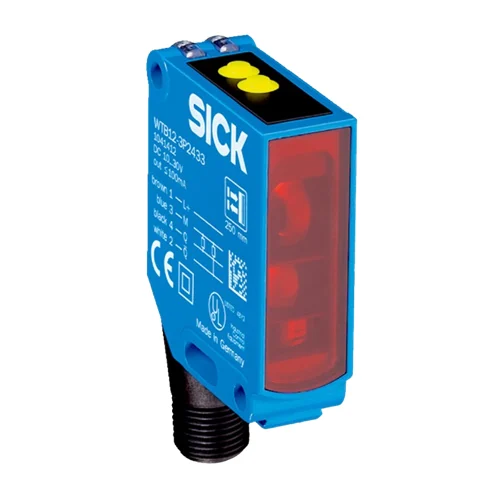
SICK 1041438 WL12-3P1731 PNP Coaxial Retroreflective Sensor

USD 212.94

WL12-3P1731 offers 0–5 m sensing on PL80A, coaxial red-light retroreflection, complementary PNP outputs, 1,500 Hz switching and a 3 m four-wire PVC cable.

SKU SICK-1041438 Category
SICK W12-3

SICK WL12-3P1731 PNP Coaxial Retroreflective Sensor

BrandSICK
Model IdentifierWL12-3P1731
Official Part Number1041438

Technical Overview

The SICK WL12-3P1731 is a polarized retroreflective photoelectric sensor with autocollimation/coaxial optics and no reflector minimum distance. Its sensing range is 0–5 m on a PL80A reflector, with a 0–7 m maximum range. A 640 nm red LED forms a 100 mm spot at 3 m, and a five-turn potentiometer adjusts sensitivity. Complementary PNP outputs provide light and dark switching states, with response no greater than 330 µs under resistive load and 1,500 Hz switching at a 1:1 light/dark ratio. The metal housing has a PMMA front screen and IP66/IP67/IP69K protection. A 3 m four-wire PVC cable connects the sensor, and two BEF-KH-W12 clamps with screws are supplied.

Coaxial polarized red-light retroreflective sensor with 0–5 m PL80A sensing, complementary PNP outputs, 1,500 Hz switching and a 3 m PVC cable.

Key Features

  • Polarized retroreflective sensing with autocollimation/coaxial optics
  • No reflector minimum distance; 0–5 m sensing and 0–7 m maximum on PL80A
  • 640 nm red LED; Ø100 mm spot at 3 m; approximately 1.5° dispersion
  • Five-turn sensitivity potentiometer
  • Complementary PNP outputs with light/dark switching
  • ≤330 µs response with resistive load; 1,500 Hz at 1:1 light/dark ratio
  • 10–30 V DC; 30 mA without load; output current ≤100 mA
  • 3 m four-wire PVC cable; do not bend below 0 °C
  • Metal housing; PMMA front screen; IP66/IP67/IP69K
  • Two BEF-KH-W12 mounting clamps with screws supplied

Place the reflector without a minimum standoff using coaxial optics and deliver complementary PNP events when objects interrupt the polarized red return beam.

Technical Specification Matrix

ParameterValue
Functional principlePhotoelectric retroreflective sensor with polarization filter
Optical designAutocollimation/coaxial optics; no reflector minimum distance
Sensing range0–5 m with PL80A reflector
Maximum sensing range0–7 m with PL80A reflector
Other reflector rangesSensing / typical maximum: C110A 0–3 / 0–4.5 m; PL50A 0–3.5 / 0–5 m; PL40A 0–3.5 / 0–5 m; PL30A 0–3 / 0–4 m; PL20A 0–2 / 0–3 m; Diamond Grade tape 0–1 / 0–1.5 m
Light sourceVisible red LED; 640 nm
Average LED service life100,000 h at +25 °C
Light spot sizeØ100 mm at 3 m
Angle of dispersionApproximately 1.5°
AdjustmentSensitivity potentiometer, five turns
Switching outputComplementary PNP outputs Q and Q̅
Switching modeLight/dark switching
PNP signal HIGH/LOWHIGH > supply voltage −2.5 V; LOW approximately 0 V
Output current≤100 mA
Response time≤330 µs signal transit time with resistive load
Switching frequency1,500 Hz at 1:1 light/dark ratio
Power supply10–30 V DC; short-circuit-protected network, maximum 8 A
Ripple<5 Vpp; remain within supply-voltage tolerances
Current consumption30 mA without load
Protection classIII
Circuit protectionSupply reverse-polarity protection; interference suppression; output overcurrent and short-circuit protection
Connection3 m four-wire PVC cable; do not bend below 0 °C
Conductor functionsCD-094: BN=L+; WH=Q̅; BU=M; BK=Q
Housing materialMetal
Front screen materialPMMA plastic
MountingM4 threaded holes, 4 mm deep; Ø4.2 mm mounting holes
Items suppliedTwo BEF-KH-W12 clamps including screws
IndicatorsYellow: received-light condition; green: supply voltage active
IP ratingIP66 / IP67 / IP69K
Operating temperature−40 to +60 °C
Storage temperature−40 to +75 °C
UL filesNRKH.E181493 and NRKH7.E181493
MTTFD1,543 years
DCavg0%
Physical Weight (kg)0.25

Industrial Applications

1. Counting separated opaque packages on a conveyor

A conveyor can place the sensor and PL80A reflector across a path carrying separated opaque packages. Each package interrupts the polarized red return beam and produces complementary PNP state changes for an external counter. The 0–5 m sensing range supplies the installed-separation basis, while the 1,500 Hz rating and resistive-load response define timing limits for distinct package passages.

Problem Solved

Interrupted return-light transitions provide external counting logic with package-passage events, supporting load tracking with only the passive reflector mounted opposite the wired sensor.

Package counting Complementary PNP 1,500 Hz

2. Monitoring continuity of an opaque strip feed

A strip feeder can align the sensor and reflector so the expected opaque material blocks the optical return path. A break or empty roll restores light reception, and external process logic evaluates the sustained output change. Five-turn sensitivity adjustment establishes reception for the installed reflector, with the reflector-specific ranges determining the initial separation limits for commissioning.

Problem Solved

A sustained received-light change gives external feeder logic a material-loss reference, helping identify an interrupted opaque strip before processing continues without the expected material.

Strip continuity Sensitivity adjustment Reflector return

3. Recognizing a load that remains at a transfer handoff

A transfer handoff can position the sensor and reflector across the expected load location and use the PNP states as an occupancy input. External control times the interrupted-beam condition relative to the normal release sequence. Coaxial optics permit reflector placement without a minimum standoff, while setup checks load opacity, beam coverage and the selected reflector’s documented range.

Problem Solved

A persistent interrupted return beam gives external transfer logic a basis for recognizing an occupied handoff, helping coordinate upstream release when the monitored load has not cleared.

Transfer occupancy External timing Coaxial optics

Select your currency