1. Pneumatic End-Position Sequencing
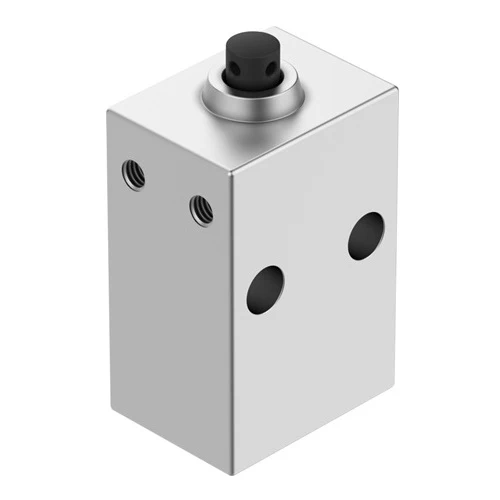
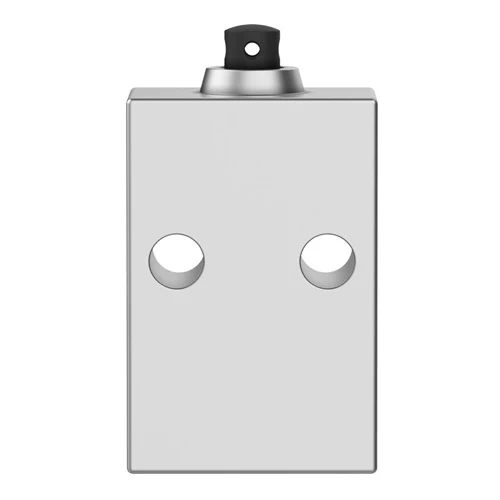
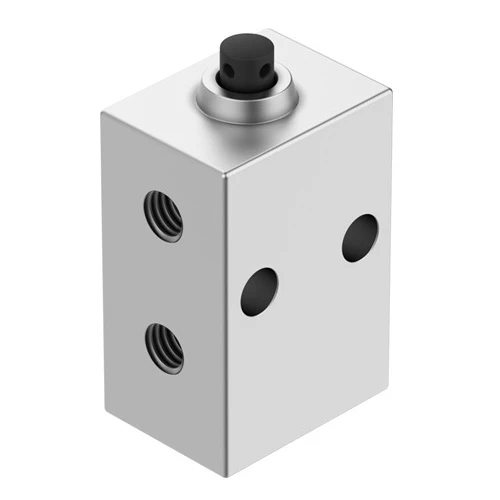
A moving machine carriage reaches a actuating stem positioned at its travel endpoint. Mechanical contact operates the direct 3/2 normally closed valve, providing a pneumatic switching event for the next stage of a pneumatic sequence. M5 connections and 80 l/min nominal flow characterize the compact signal interface, while the specified 23 N actuating force defines the stem-contact requirement.
Problem Solved
The stem converts a physical endpoint event into pneumatic switching, allowing the sequence to respond to mechanism position through a direct mechanical valve interface.
Stem actuation
3/2 NC monostable
M5 ports
2. Workpiece-Contact Pneumatic Presence Signal
A fixture presents a workpiece against a actuating stem to establish a pneumatic presence signal before a process step. This valve changes its normally closed 3/2 state through direct mechanical actuation, requiring no electrical coil supply. Its 23 N actuating force and through-hole mounting provide documented parameters for arranging the fixture contact and supporting the valve body.
Problem Solved
Mechanical contact gives the pneumatic circuit a workpiece-present switching event, addressing absent-part sequencing without requiring an electrical sensor output at the contact point.
23 N actuation
Direct operation
Through-hole mounting
3. Cam-Triggered Pneumatic Cycle Pulse
A rotating or translating cam contacts the stem during one part of a machine cycle. The direct mechanical 3/2 monostable valve supplies a switching interval tied to that contact, rather than a programmed electrical timing command. The 2 mm nominal size, M5 connections and 80 l/min nominal flow define the selected pneumatic signal component without assigning an unsupported maximum cam speed.
Problem Solved
Cam contact links pneumatic switching to the mechanical cycle position, giving the control circuit a locally generated timing event through the monostable stem valve.
Cam contact
80 l/min nominal
2 mm nominal size