1. Multi-Channel Battery Charge/Discharge Test Cabinets
Integrated directly into high-density industrial battery cycle-testing systems (such as lithium-ion formation and grading machines) to aggregate Modbus TCP communications from individual cell-monitoring boards to the host computer.
Problem SolvedRepetitive manual reconfiguration or testing loops can trigger broadcast storms that crash cabinet communication. The physical VLAN switch isolates test channels from causing network-wide interference, while hardware loop detection alerts operators instantly via local flashing LEDs without pausing the main battery cycle.
Battery Test CabinetVLAN IsolationLoop DetectionFast EthernetModbus TCP
2. Access Layer Surveillance (CCTV) Network Partitioning
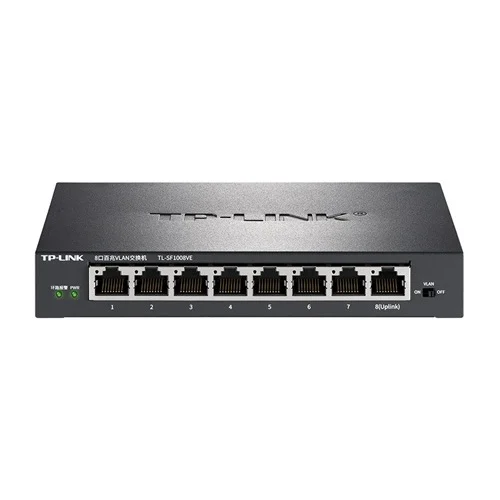
Serves as an access-layer switch in localized CCTV topologies, routing up to 7 isolated IP security cameras on Ports 1-7 directly to a central Network Video Recorder (NVR) connected to Port 8.
Problem SolvedStandard unmanaged switches allow interconnected IP cameras to communicate with one another, creating severe vulnerabilities for ARP poisoning or malicious packet injection if a single camera cable is physically intercepted. Hardware VLAN toggle prevents camera-to-camera communication entirely, securing the local network layout.
Port IsolationIP Camera NetworkingNVR ConnectionBroadcast Storm SuppressionSecurity Layering
3. Shop Floor PLC and HMI Device Clustering
Establishes a localized physical communication node for linking Programmable Logic Controllers (PLCs), Human-Machine Interfaces (HMIs), and localized field sensors on production shop floors.
Problem SolvedIndustrial floors expose network hardware to structural vibration and EMI, which degrade plastic-shelled SOHO equipment. The TL-SF1008VE’s rigid steel enclosure provides physical durability and EMI shielding, while its fanless passive cooling design ensures continuous operation in high-dust and airborne particulate settings.
Steel CasingFanless DesignIndustrial AutomationPLC CommunicationsEMI Shielding