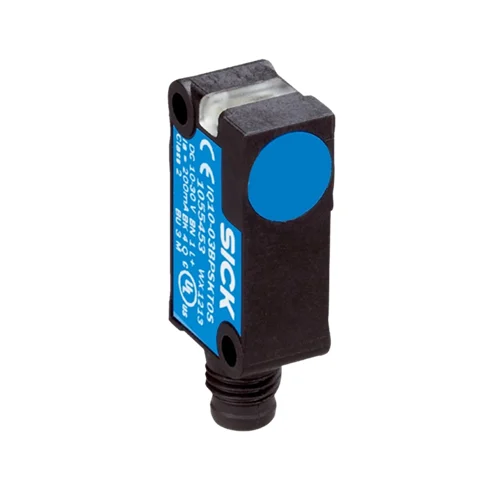
SICK 1055449 IQ10-03BPOKW2S PNP NC Inductive Sensor

USD 46.54

IQ10-03BPOKW2S offers 3 mm nominal and 2.43 mm assured sensing, flush installation, PNP normally-closed output, a 2 m PVC cable and IP68.

SKU SICK-1055449 Category
SICK IQB

SICK IQ10-03BPOKW2S PNP NC Inductive Sensor

BrandSICK
Model IdentifierIQ10-03BPOKW2S
Official Part Number1055449

Technical Overview

The SICK IQ10-03BPOKW2S is a rectangular inductive proximity sensor for flush installation. Its nominal sensing range is 3 mm and assured range is 2.43 mm, with reference reduction factors for stainless steel and nonferrous targets. The PNP normally-closed output operates at a switching frequency of 2,000 Hz and connects through a 2 m three-wire PVC cable. The VISTAL plastic housing and sensing face provide IP68 protection, with a 270° LED indicator and mounting holes shown in the dimensional drawing. Operation uses 10–30 V DC, continuous output current up to 200 mA and a no-load current of 10 mA. The operating temperature range is −25 to +75 °C, with tightening torque limited to 1 Nm.

Flush rectangular inductive sensor with 3 mm nominal range, PNP normally-closed output, 2,000 Hz switching, 2 m PVC cable and IP68 protection.

Key Features

  • Rectangular inductive proximity sensor for flush installation
  • 3 mm nominal range; 2.43 mm assured sensing range
  • PNP normally-closed output; DC three-wire configuration
  • 2,000 Hz switching; availability delay ≤100 ms
  • 10–30 V DC; continuous output current ≤200 mA; no-load current 10 mA
  • 2 m three-wire PVC cable; 0.25 mm² conductors; Ø3.7 mm cable
  • VISTAL plastic housing and sensing face; IP68 to EN 60529
  • 270° LED indicator; Ø3.2 mm mounting holes; tightening torque ≤1 Nm
  • Short-circuit and power-up pulse protection
  • −25 to +75 °C operation; documented material reduction factors

Mount a flush rectangular sensing face beside a metal target and deliver normally-closed PNP transitions through a three-wire cable.

Technical Specification Matrix

ParameterValue
Functional principleInductive proximity sensing
Housing designRectangular
InstallationFlush
Nominal sensing range Sn3 mm
Assured sensing range Sa2.43 mm
Switching outputPNP
Output functionNormally closed (NC); DC three-wire
Switching frequency2,000 Hz
Connection2 m three-wire PVC cable
Conductor cross-section0.25 mm²
Cable diameterØ3.7 mm
Conductor functionsCD-003: BN=L+; BK=NC; BU=M
Power supply10–30 V DC
Ripple≤10% of supply voltage
Voltage drop≤2 V at maximum continuous current
Availability delay≤100 ms
Hysteresis5–15%
Reproducibility≤2% of Sr at constant supply voltage and ambient temperature
Temperature drift±10% of Sr
Continuous output current≤200 mA
No-load current10 mA
Circuit protectionShort-circuit protection; power-up pulse protection
Housing materialVISTAL plastic
Sensing face materialVISTAL plastic
Mounting holesØ3.2 mm
Tightening torque≤1 Nm
Indication270° LED indicator
IP ratingIP68 to EN 60529
Operating temperature−25 to +75 °C
Shock resistance30 g, 11 ms
Vibration resistance10–55 Hz, 1 mm
EMCEN 60947-5-2
Material reduction factorsReference values, may vary: V2A/304 stainless steel 0.7; aluminum 0.4; copper 0.3; brass 0.5
Installation clearancesA=0, B=10, C=10.3, D=9, E=0, F=24, G=0 mm; letters refer to manufacturer installation graphic

Industrial Applications

1. Checking a metal slide at its working position

A compact machine slide can present a metal reference tab to the flush rectangular sensing face at its intended working position. External sequencing logic reads the normally-closed PNP state after motion settles. Commissioning establishes target coverage and operating gap against the 3 mm nominal and 2.43 mm assured ranges, including the reduction factor for the actual metal.

Problem Solved

A local metal-tab reference gives external sequencing logic a working-position condition, helping coordinate a dependent operation after the slide reaches its selected sensing location.

Slide position Flush installation Normally-closed PNP

2. Counting separated metal parts in a feeder

A feeder can guide separated metal parts past the sensing face and send PNP transitions to external counting electronics. The 2,000 Hz switching rating provides the stated frequency basis for commissioning. Setup establishes part coverage, operating gap and spacing so that the normally-closed output changes distinctly for each passage, with material reduction factors applied to the actual target.

Problem Solved

Distinct inductive transitions give the external counter metal-part passage events, helping track feed quantities without physical contact or dependence on the target surface color.

Metal-part count 2,000 Hz Inductive sensing

3. Recognizing missing motion events from a rotating mechanism

A rotating mechanism can carry spaced metal tabs past the sensor while external monitoring logic times the normally-closed PNP transitions. The controller compares the interval between events with the commanded running state and recognizes a prolonged absence. Commissioning validates tab spacing, sensing gap and material, with motion speed kept within the 2,000 Hz switching rating.

Problem Solved

A recurring target event gives external motion monitoring a reference for continued operation, helping detect an unexpectedly stationary mechanism when the anticipated inductive transitions stop.

Motion events External timeout Metal tabs

Select your currency