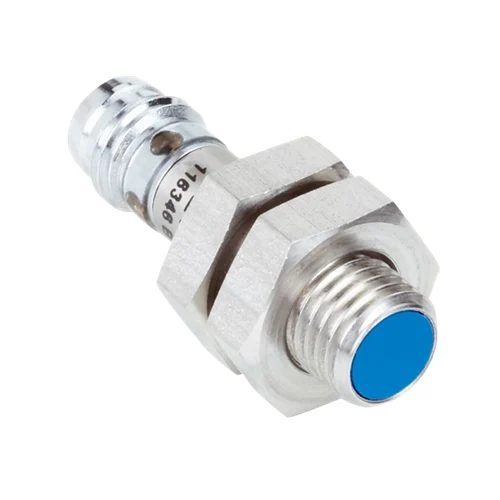
1. Confirming a metal fixture at its seated stop
A fixture can bring a defined metal target close to the flush M8 sensing face when it reaches its seated stop. External sequencing logic reads the PNP normally-open condition after movement settles and the sensor’s availability delay has elapsed. Setup establishes the working gap from representative targets, accounting for material reduction, hysteresis and position tolerance rather than treating nominal range as an assured clearance.
Problem Solved
A seated-metal reference helps external sequencing distinguish a presented fixture from an empty stop, using an inductive switching condition established for the actual target and gap.
Fixture position
Flush installation
PNP confirmation
2. Counting separated metal features on a moving wheel
A wheel can present separated metal features to the sensing face and generate PNP transitions for an external counter. The 3,000 Hz rating provides a switching-frequency reference, while the actual feature width, spacing and operating gap are verified at the intended speed. Installation respects the manufacturer clearance geometry and checks the target material against the listed range-reduction factors.
Problem Solved
Repeated metal-passage signals help external counting logic track wheel motion, with feature geometry and sensing margin verified so adjacent features produce distinguishable switching conditions.
Feature counting
3,000 Hz
Metal wheel
3. Checking a metal insert before an assembly step
An assembly station can present the expected insert near the flush sensing face and sample its PNP normally-open state before proceeding. The detector is positioned so the insert changes the sensed condition relative to the empty carrier. Commissioning uses the actual insert material and seated tolerance, checks surrounding metal clearance and verifies that the switching margin remains usable over the operating temperature range.
Problem Solved
An insert-presence reference helps external assembly logic identify an omitted metal component before a dependent operation, with sensitivity established for the actual carrier and insert arrangement.
Insert presence
Assembly check
Material-dependent range