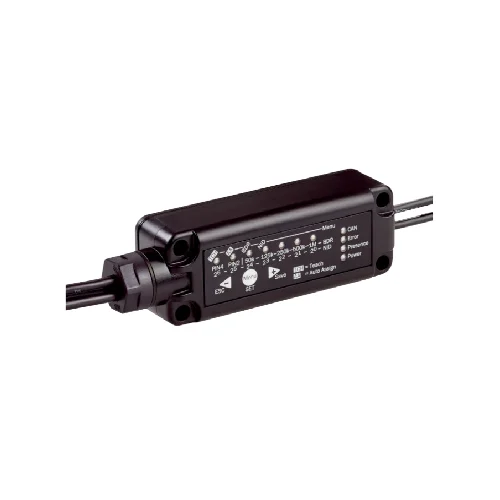
Technical Overview
The SICK FC1A-DZ2A1A is a FlexChain Host for integrating compatible photoelectric sensors and light-grid devices into an evaluated sensing system. Two cabled M8 guest ports connect the sensing branches, while CANopen, one configurable I/O and Q1/IO-Link connect the host to external control. USB and SOPAS ET support sensor and interface parameterization, zone definition, measurement functions, logic and diagnostics. IO-Link V1.1 operates at COM3 with 32-byte process data, and CANopen supports 50 kbit/s to 1 Mbit/s. The 24 V DC host has an ABS housing, IP65/IP67 protection and a system-dependent response no greater than 35 ms. Two FlexChain terminators are supplied.
FlexChain Host with CANopen, IO-Link V1.1, two M8 guest ports, USB/SOPAS ET configuration, zone definition and logic functions.
Key Features
- FlexChain Host for compatible photoelectric sensing and light-grid guests
- Two cabled M8 four-pin female guest ports, A and B
- CANopen interface, 50 kbit/s to 1 Mbit/s
- IO-Link V1.1 COM3, 230.4 kbit/s; 32-byte process data; cycle ≥2.3 ms
- CANopen + one I/O + one Q/IO-Link; Q2 and In1 share one connection
- USB/SOPAS ET configuration, sensor/interface parameterization and diagnostics
- Zone definition, measurement functions and Base logics Smart Task
- System-dependent response ≤35 ms; initialization <1 s
- 24 V DC ±20%; 600 mA at maximum guest count; output ≤100 mA
- ABS housing; IP65/IP67; −25 to +50 °C operation; two terminators supplied
Evaluate connected FlexChain sensing branches with configurable zones and logic, then pass process information to external control over CANopen or IO-Link.
Technical Specification Matrix
| Parameter | Value |
|---|
| Product type | FlexChain Host |
| Supported sensing system | FlexChain sender/receiver, photoelectric retro-reflective and proximity sensors, and light-grid system |
| Configuration | USB connection with SICK SOPAS ET |
| Parameterization functions | Sensor parameterization; zone definition; measurement and logic functions; interface parameterization; diagnostics |
| Smart Task | Base logics |
| Synchronization | Cable |
| Response time | ≤35 ms, depending on system configuration |
| IO-Link | V1.1; COM3, 230.4 kbit/s |
| IO-Link cycle time | ≥2.3 ms |
| Process data | 32 bytes |
| CANopen | 50 kbit/s to 1 Mbit/s |
| Inputs/outputs | CANopen + one I/O + one Q (IO-Link) |
| Digital outputs | Two, Q1 and Q2; Q2/In1 shared |
| Digital input | One, In1 |
| Output current | ≤100 mA |
| Output load | Capacitive 100 µF; inductive 1 H |
| Power supply | 24 V DC ±20%; reverse-polarity protected; operate in short-circuit-protected network, maximum 8 A |
| Current consumption | 600 mA at 24 V with maximum number of guests |
| Initialization time | <1 s |
| Guest ports | Port A and B: cable with M8 four-pin female connector, 1.5 m |
| PLC connection | Cable with M12 five-pin male connector, 0.5 m |
| CANopen connection | Cable with M12 five-pin male connector, 0.3 m |
| USB connection | USB Micro-B service/configuration connection, as shown in connection diagram |
| PLC pin assignment | 1 BN=L+; 2 WH=Q2/In1; 3 BU=M; 4 BK=Q1/C; 5 GY=not connected |
| CANopen pin assignment | 1 BN=not connected; 2 WH=not connected; 3 BU=GND; 4 VT=CAN1_H; 5 OG=CAN1_L |
| Port A/B pin assignment | 1 BN=CAN_H; 2 WH=CAN_L; 3 BU=+12 V; 4 BK=GND |
| USB pin assignment | 1 WH=+5 V; 2 BU=Data−; 3 BK=Data+; 4=not connected; 5 GY=GND |
| Housing material | ABS plastic |
| IP rating | IP65 / IP67 |
| Circuit protection | Supply reverse-polarity protection; output Q short-circuit protection; interference pulse suppression |
| Protection class | III |
| Operating temperature | −25 to +50 °C |
| Storage temperature | −25 to +70 °C |
| Shock resistance | Single 30 g, 11 ms, six per axis; continuous 25 g, 6 ms, 1,000 per axis |
| Vibration resistance | Sinusoidal 20–2,000 Hz, 10 g, three hours per axis |
| EMC | EN 61000-6-2 and EN 61000-6-3 |
| Items supplied | One FlexChain Host, one Quick Start Guide and two FlexChain terminators, 2119481 |
| Mounting drawing | 82.6 mm mounting-hole spacing; two Ø5.5 mm holes |
| Physical Weight (kg) | 0.17 |
Industrial Applications
1. Combining sensing conditions across a transfer station
A transfer station can connect compatible FlexChain sensing guests to the host branches and define zones associated with the material path. Parameterized logic combines the connected sensing conditions, and CANopen or the documented local I/O carries process information to external sequencing. Commissioning establishes the guest arrangement and zone definitions, accounting for the system-dependent response and the individual guest sensing characteristics.
Problem Solved
A host-level zone and logic configuration gives external transfer control an evaluated process reference, helping coordinate material movement across multiple connected sensing locations.
Zone logic
Connected guests
CANopen
2. Changing sensor settings for a production recipe
A production station handling different component formats can use USB and SOPAS ET to establish the corresponding sensor parameters and zone definitions in its FlexChain arrangement. The host also provides interface and measurement-function parameterization so that the evaluated conditions match the intended process setup. Commissioning checks each recipe against representative components and the capabilities of its connected sensing guests before production begins.
Problem Solved
Central configuration of the sensing arrangement helps commissioning align sensor settings and evaluated zones with the production recipe, reducing repeated adjustment at separate sensing locations.
Recipe setup
SOPAS ET
Sensor parameters
3. Diagnosing a distributed sensing arrangement
A maintenance workstation can connect through the host USB interface and use SOPAS ET diagnostics while presenting reference targets to the connected FlexChain guests. The host configuration and diagnostic functions help staff relate observed conditions to the relevant sensing branch or configured zone. The maintenance procedure compares those observations with external control readings and the documented wiring of the installed system.
Problem Solved
Host-accessible diagnostics help maintenance relate an unexpected process condition to the connected sensing arrangement, supporting fault investigation without relying only on the final machine input state.
System diagnostics
USB access
Reference targets