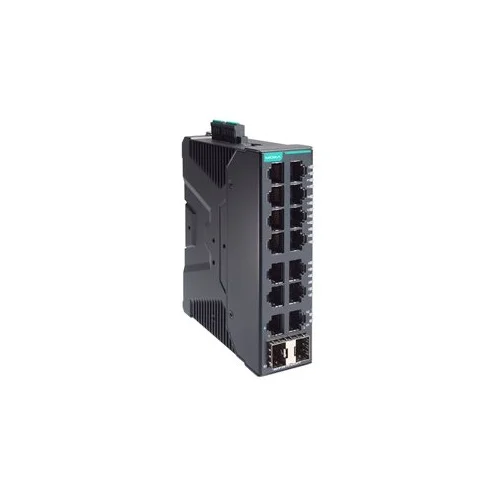
1. Industrial Automation Control Cabinets
This switch is perfectly suited for integrating various PLCs, HMIs, and sensors within an industrial control cabinet, connecting them to a higher-level SCADA system. Its compact size (3.6 cm width) and DIN-rail mounting simplify installation in confined spaces. Support for EtherNet/IP, PROFINET, and Modbus TCP ensures compatibility with diverse industrial devices.
Problem SolvedConnects diverse industrial devices using standard protocols in a rugged, space-constrained environment, ensuring reliable data exchange and network uptime through redundancy features (RSTP/STP, MRP) and dual redundant 12-48 VDC power inputs.
Industrial EthernetPLCHMISCADADIN-railCompactEtherNet/IPPROFINETModbus TCPRSTPMRPIP40Redundant Power
2. Factory Floor Networking (Non-Hazardous Areas)
Ideal for establishing a robust and secure network backbone in general factory floor environments, linking production machinery, robotic cells, and monitoring systems. The wide operating voltage range (9.6-60 VDC) provides flexibility in power sourcing, and the -10 to 60°C operating temperature suits typical industrial settings.
Problem SolvedProvides reliable and secure network connectivity for critical production equipment in environments with moderate temperature variations, protecting against dust ingress (IP40) and ensuring continuous operation through dual redundant power inputs and network redundancy protocols.
Factory AutomationIndustrial NetworkRobust ConnectivityRedundancyDual PowerIP40Operating TemperatureSecure CommunicationProduction Monitoring
3. Building Automation and Energy Management
Can be deployed in building automation systems to connect various smart building devices, such as HVAC controllers, access control panels, and energy meters, facilitating centralized monitoring and management over an IP network. The 2x 100/1000BaseSFP slots allow for fiber optic uplinks for longer distances or EMI immunity within large buildings or campuses.
Problem SolvedEnables a secure and manageable network for building infrastructure, allowing for long-distance, interference-resistant connections (fiber via SFP) to distribute network services reliably across different building sections, supporting robust data exchange and system integration.
Building AutomationSmart BuildingFiber OpticSFPRemote MonitoringEnergy ManagementSecure NetworkVLANSNMPHVAC Control