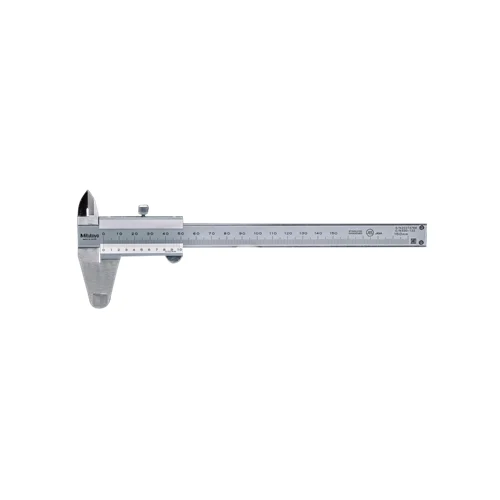
1. Precision Machinist Inspection
Utilized in high-tolerance workshops to measure milled or turned workpiece dimensions [1.2.5]. With an accuracy of ±0.03 mm and 0.02 mm resolution, it ensures components match exact engineering design blueprints.
Problem SolvedProvides reliable, electronic-free dimensional inspection that is completely immune to electromagnetic interference, battery failure, or liquid splashes in harsh machine shop environments.
outside diameterinside diametermachiningtolerance checkDIN 862vernier scale
2. Quality Assurance Step and Depth Measurement
Perfect for measuring depth of blind holes, step heights of molded parts, and groove dimensions using its flat blade depth bar and step-measuring faces.
Problem SolvedSolves the issue of measuring hard-to-reach internal cavities and stepped surfaces accurately without needing separate depth micrometers, speeding up quality inspection.
step measurementdepth bargroove depthblind holesquality control
3. Laboratory & Metrology Calibration Support
Used as a reference manual standard in toolrooms and inspection labs for secondary verification of digital and automated metrology equipment.
Problem SolvedServes as a failsafe calibration check and robust tool for teaching basic metrology, eliminating reliance on active electronic sensors for dimension verification.
metrologycalibrationmechanical referencevernierhigh accuracy