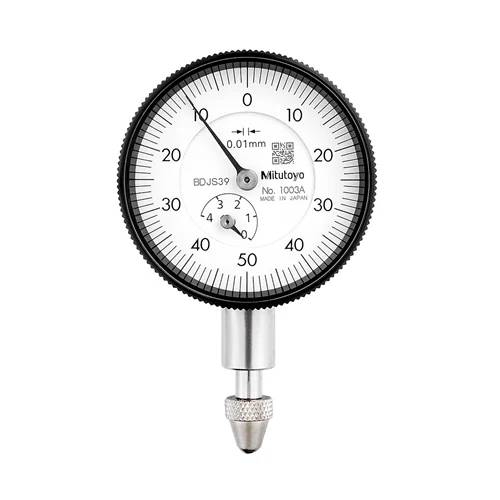
1. Precision Jig and Fixture Alignment in Confined Machine Enclosures
In CNC machining centers and automated indexing lines, tooling jigs must be aligned parallel to the spindle within sub-millimeter tolerances. The ultra-compact 36mm bezel diameter and total height under 6cm of the 1003A allow integration into tight, restricted machine corners where standard dial indicators would cause structural collisions.
Problem SolvedAvoids physical interference issues inside highly compact machine areas while providing immediate 0-50-0 balanced feedback on misalignment deviations.
CNC machiningfixture alignmentconfined space metrology36mm bezelspindle centering
2. Multi-Probe Runout and Flatness Inspection Stations
During quality control of miniature precision shafts, bearings, and turned parts, multiple points must be monitored simultaneously. Thanks to the narrow profile of the 1003A, quality engineers can cluster several indicators closely together on a single custom fixture, taking multiple concurrent flatness or runout readings.
Problem SolvedSolves the physical limitation of crowding standard-sized dial indicators on small parts, while its light 1.4N measuring force ensures delicate components do not flex during inspection.
runout inspectionmulti-probe checkingflatness verificationlow measuring forcecomparative metrology
3. Stamping Press Shut-Height and Die Position Calibration
Metal stamping dies rely on precise shut-height positioning to prevent over-compression and tool damage. Toolmakers embed the 1003A into calibration blocks to verify press bottom-dead-center repeatability. The heavy-duty 4-screw mounting and high-rigidity mechanical bearing plate ensure the indicator withstands toolroom handling impacts.
Problem SolvedEnsures die stroke consistency without the risk of battery failures typical of digital tools in high-vibration environment setups.
die height calibrationshut height settingtooling adjustmentimpact resistancehardened steel stem