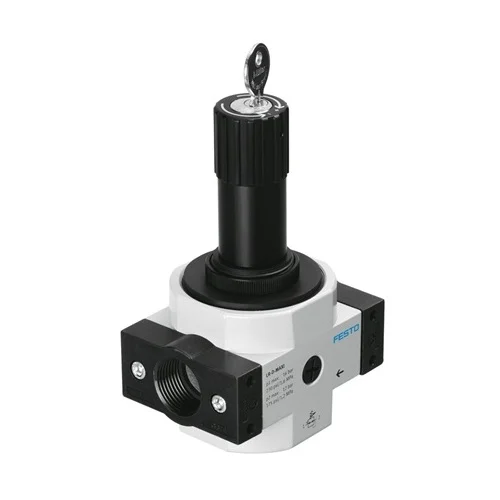
1. Robotic Gripper Pressure Control in Semiconductor Manufacturing
Utilizing the Festo LRS-1/8-D-7-O-I-MINI to regulate compressed air or inert gas to miniature pneumatic end-of-arm tooling. The compact G1/8 design integrates easily into robotic arms, and the pressure is tightly regulated within the 0.5 to 7 bar range.
Problem SolvedPrevents crushing of fragile semiconductor wafers by maintaining a strict, tamper-proof pressure limit using the integrated lock on the rotary knob. The return flow function enables rapid exhaust for fast release cycles.
End-of-Arm ToolingTamper-proof lockReturn flow function0.5 to 7 bar regulation
2. Inert Gas Pressure Regulation for Automated Adhesive Dispensing
Integrated into a micro-dispensing cabinet, this regulator uses inert gases to pressurize adhesive reservoirs. The 1000 l/min flow capacity handles rapid volumetric displacement while the primary pressure compensation keeps the output perfectly stable despite upstream compressor fluctuations.
Problem SolvedSolves the issue of inconsistent glue bead thickness. The extremely low hysteresis (0.02 MPa) ensures precise pressure control, while the lockable rotary knob prevents unauthorized operators from altering the dispensing pressure on the shop floor.
Primary pressure compensationInert gases0.02 MPa hysteresisAdhesive dispensing
3. Leak Testing Stations for Medical Devices
Employed in automated leak decay testing jigs where accurate, repeatable pressurization of test specimens is required. The directly actuated diaphragm regulator maintains a steady output pressure.
Problem SolvedSolves the problem of false leak detection caused by input pressure drops. The primary pressure compensation combined with secondary venting guarantees stable test conditions, and the G1/8 connection fits the miniature pneumatic circuitry needed for small medical devices.
Leak decay testingPrimary pressure compensationG1/8 connectionSecondary venting