
Sale!

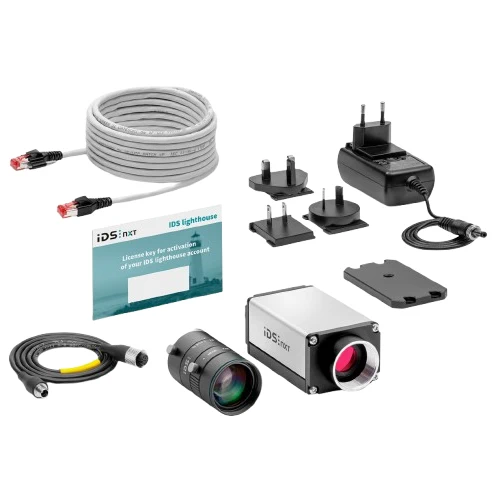
IDS NXT rio Experience Kit 1 Month & 3 Months

$ 2,061.00 $ 3,954.75Price range: $ 2,061.00 through $ 3,954.75

Evaluate edge AI vision with the IDS NXT rio Experience Kit. Flexible 1-month and 3-months smart camera evaluation for inspection and automation projects.

SKU N/A Category

IDS NXT rio Experience Kit – AI Vision Development Starter Kit

Product Description

The IDS NXT rio Experience Kit is a complete AI vision evaluation package designed for engineers and developers who want to explore intelligent image processing directly at the edge. Centered around the IDS NXT rio smart camera with a Sony IMX273 global shutter CMOS sensor, the kit delivers 1.58 MP resolution (1456 × 1088) for reliable capture of moving objects and dynamic scenes. With GigE connectivity, opto-isolated I/O, and C-mount lens support, it provides a professional hardware foundation for rapid AI vision prototyping in industrial environments.

Built to accelerate real-world validation, the IDS NXT rio Experience Kit enables users to test AI-based inspection, classification, and automation concepts under actual operating conditions. Hardware triggering, flexible exposure control, and integrated image processing features ensure stable performance and consistent results. Available in 1-month or 3-month experience durations, the kit allows teams to train models, refine workflows, and assess feasibility before full deployment, reducing technical risk and shortening development cycles for AI-powered machine vision systems.


Technical Capabilities

  • 1.6 MP Global Shutter CMOS Sensor – 1456 × 1088 resolution using Sony IMX273 for distortion-free imaging of moving objects

  • Up to 41 fps (Triggered Mode) – Supports responsive, event-driven acquisition for automation and AI-based inspection tasks

  • GigE Vision Interface with PoE – Stable, long-distance data transmission with simplified cabling via Power over Ethernet or 12–24 V DC input

  • Hardware Trigger & Industrial I/O – Opto-isolated trigger, inputs, outputs, and flash control via 12-pin M12 connector for precise system synchronization

  • Advanced Image Control & Pre-Processing – Auto exposure, auto gain, white balance, LUT, gamma correction, ROI, and sensor/FPGA decimation

  • Edge-AI Evaluation Platform – Designed for rapid testing, training, and validation of AI vision applications directly on the camera during the experience period


Ideal Applications

1. High-Speed Conveyor Inspection for Small Parts

In automated manufacturing lines, small components such as fasteners, stamped parts, or connectors move at high speed, making image distortion a major challenge. A global shutter sensor captures the entire image at once, ensuring accurate geometry even when parts are in motion. With hardware-triggered acquisition, images are taken precisely when a part enters the inspection zone. AI models can then reliably identify defects such as missing features, deformations, or incorrect dimensions. The moderate resolution keeps processing latency low, allowing decisions to be made in real time without requiring powerful external computing resources.

2. Robot-Guided Pick-and-Place Verification

Robotic handling systems depend on precise visual feedback to confirm object orientation before gripping. Using a global shutter sensor, rotating or vibrating parts are imaged without skew, which simplifies AI-based pose recognition. Triggered image capture synchronized with robot motion ensures consistent viewpoints during each cycle. This allows the system to verify alignment, detect flipped or misplaced items, and prevent gripping errors. As a result, robots achieve higher placement accuracy and reduced downtime, especially in flexible production cells where part types or orientations frequently change.

3. Intelligent Traffic and Access Monitoring

In access control and smart infrastructure systems, vehicles and people often move quickly through monitored areas. A global shutter sensor prevents motion artifacts that can interfere with detection and classification. With adjustable exposure control, the system adapts to changing lighting conditions between outdoor and indoor zones. AI processing at the edge enables tasks such as vehicle classification, entry counting, or anomaly detection without relying on remote servers. This improves response time and data privacy while allowing compact camera installations at gates, entrances, or industrial perimeters.

4. Automated Optical Inspection of Printed Labels

Packaging lines require continuous verification of labels, codes, and markings on products in motion. A global shutter sensor captures sharp images of moving packages, preserving fine details such as text edges and barcode patterns. AI-based inspection algorithms can then validate readability, placement, and completeness of printed information. Trigger synchronization with conveyor movement ensures consistent image timing, while controlled exposure helps manage reflections from glossy surfaces. This approach reduces labeling errors and minimizes product recalls caused by incorrect or unreadable markings.

5. Machine Vision for Laboratory Automation

Laboratory automation systems often involve fast mechanical movements, such as rotating stages or sliding sample carriers. A global shutter sensor ensures accurate imaging of samples during motion, which is essential for reliable AI-assisted verification. Vision algorithms can confirm sample presence, detect misplacement, or monitor handling steps performed by robots. Precise exposure control supports stable imaging under artificial lighting commonly used in laboratories. This improves process reliability, reduces manual checks, and supports scalable automation in research and diagnostic environments.

Select your currency