
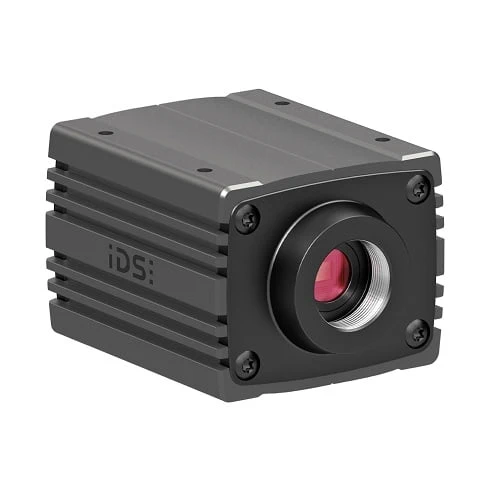
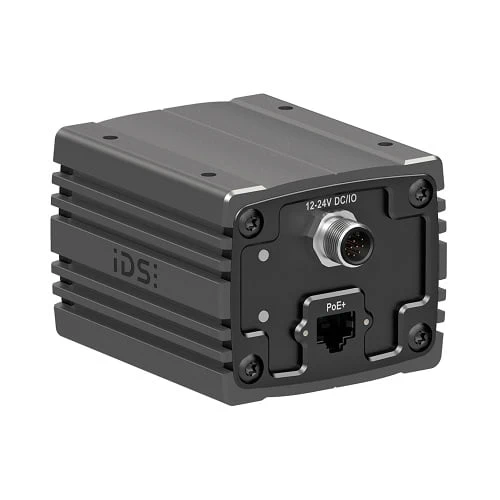
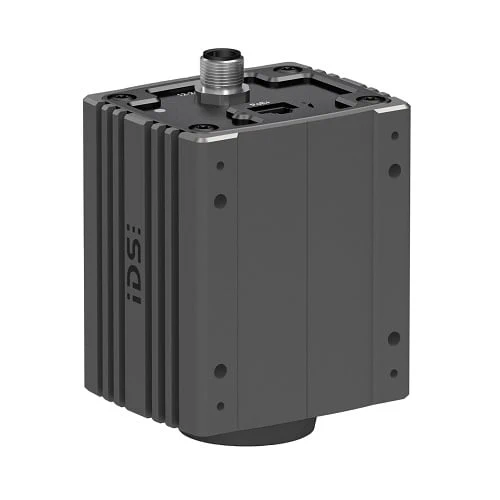
Specifications
- Color: GV-7000WP-C-HQ (1007804)
- Mono: GV-7000WP-M-GL (1007805)
| Feature | Details | Application Advantage |
|---|---|---|
| Sensor Brand & Model | Sony IMX253 (Color: IMX253LQR / Mono: IMX253LLR) | Proven industrial sensor with stable performance and low noise |
| Interface | GigE Vision (RJ45, screwable) | Reliable long-distance data transmission in industrial networks |
| Interface Speed | 1 Gbps Ethernet | Consistent bandwidth for high-resolution image streaming |
| Resolution (H × V) | 4112 × 3008 pixels (12.37 MP) | Captures fine details for inspection and measurement |
| Optical Area (H × V) | 14.159 × 10.371 mm | Supports wide field-of-view imaging |
| Optical Format | 1.1″ (Diagonal 17.55 mm) | Ideal for high-end industrial C-mount lenses |
| Lens Mount | C-Mount | Broad compatibility with industrial optics |
| Pixel Size | 3.45 µm × 3.45 µm | Balanced sensitivity and spatial resolution |
| Image Memory | 2032 MB on-camera | Supports burst capture and stable data handling |
| Frame Rate @ Max. Resolution | Up to 45 fps (freerun / trigger) | Enables real-time inspection and synchronization |
| Shutter | Global Shutter | Eliminates motion distortion for moving objects |
| Exposure Time | 0.022 ms to 2000 ms (long exposure up to 44.5 s) | Flexible imaging across fast and low-light scenarios |
| Trigger & Flash I/O | Multiple opto-isolated trigger inputs and flash outputs via M12 | Precise synchronization with external devices |
| Power Supply | 12–24 V DC or PoE+ | Simplified cabling and flexible installation |
| Software Tools | IDS peak SDK, GenICam compliant | Seamless integration into machine vision systems |
| Environmental Tolerance | Operating: 0 °C to 55 °C, 20–80% RH non-condensing | Reliable operation in industrial environments |
| Housing Protection | IP30, aluminum housing | Robust design for control cabinets and production floors |
| Size & Weight | 60 × 75 × 94.5 mm, approx. 550 g | Compact form factor for space-constrained systems |
Ideal Applications
1. High-Speed Conveyor Inspection for Precision Components
In automated manufacturing lines, components move continuously, making motion distortion a major challenge for reliable inspection. A global shutter sensor captures the entire image at the same instant, preserving geometry even when parts are in motion. The high 12 MP resolution allows small defects, edge damage, and dimensional inconsistencies to be detected on metal or molded components. Precise hardware triggering synchronized with conveyor movement ensures consistent image timing, while short exposure combined with controlled lighting effectively freezes motion. This results in stable inspection accuracy, reduced false rejections, and sustained throughput in high-volume production environments.
2. Automated Optical Inspection in Electronics Assembly
Electronic assemblies require detailed imaging to identify solder joint defects, missing components, or fine trace irregularities. The large sensor area provides uniform sharpness across wide circuit boards, reducing the need for multiple inspection views. Global shutter operation prevents distortion as boards move through inspection stations, ensuring correct component geometry. High bit-depth imaging improves contrast between reflective solder, copper traces, and substrates under complex lighting. Adjustable regions of interest and image optimization features help balance inspection speed and detail, supporting consistent quality control across diverse PCB designs and production speeds.
3. Precision Dimensional Measurement and Metrology
Measurement systems depend on stable imaging to deliver repeatable dimensional results. High-resolution global shutter imaging ensures accurate edge definition even when parts experience slight vibration during capture. Consistent exposure control and synchronized illumination improve measurement repeatability across multiple inspection cycles. The ability to capture fine details supports sub-pixel measurement techniques used in advanced metrology. Flexible system layouts enabled by Ethernet-based connectivity allow easy integration into inline or offline measurement stations, supporting reliable dimensional verification for machined, stamped, and molded components in industrial quality assurance workflows.
4. Vision-Guided Robotic Pick-and-Place Systems
Robotic automation relies on precise visual feedback to determine object position and orientation. Distortion-free global shutter imaging ensures reliable localization of parts during rapid robot movement. High frame rates support responsive vision updates, while precise triggering aligns image capture with robot motion phases. The wide sensor coverage reduces blind spots and supports larger work envelopes. These capabilities improve pick accuracy, reduce handling errors, and enable faster cycle times in bin picking, assembly, and material handling applications operating under dynamic conditions.
5. Synchronized Multi-Camera Production Monitoring
Complex production processes often require multiple cameras to observe different stages simultaneously. Using the same global shutter sensor model across cameras ensures consistent timing and geometry. Hardware-based synchronization allows images to be captured at precisely the same moment, eliminating temporal mismatch between views. High on-camera buffering and stable data transmission support continuous operation without dropped frames. This approach enables accurate comparison between views, supports multi-angle analysis, and improves reliability in production monitoring, packaging inspection, and process validation systems where timing consistency is critical.