1. High-Speed Defect Detection on Production Lines
This camera is ideally suited for inspecting fast-moving products on an assembly line, such as electronic components, pharmaceutical packaging, or small mechanical parts. Its high frame rate of 525 fps and global shutter technology prevent motion blur, ensuring crisp images for precise defect detection.
Problem SolvedRapidly identifies minute surface defects, misalignments, or missing components on products moving at high speeds, significantly improving quality control and reducing manufacturing errors that would be missed by slower cameras or human inspection. The 720x540 resolution provides sufficient detail for typical VGA-level inspections.
Machine VisionQuality ControlDefect InspectionGlobal ShutterHigh Frame RateProduction AutomationAssembly Line
2. Robotics for Pick-and-Place and Assembly
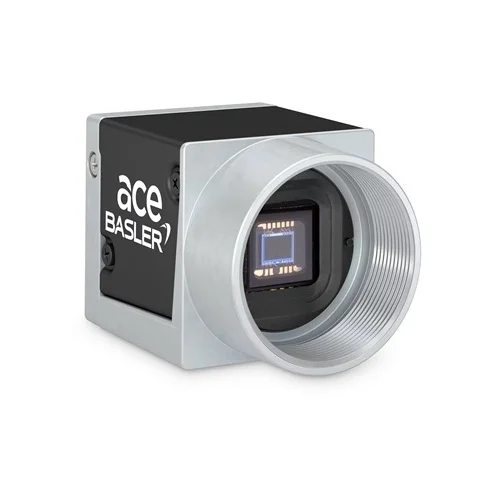
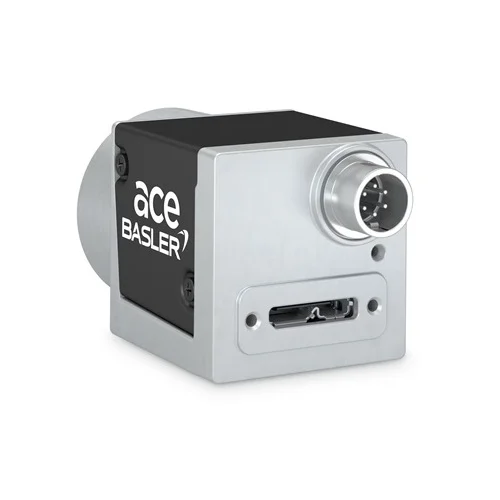
The compact dimensions (29.3 x 29 x 29 mm) and C-mount compatibility make this camera excellent for integration onto robotic arms or within confined vision systems for guiding robots in precise pick-and-place operations, intricate assembly tasks, or object recognition. The global shutter ensures accurate object localization even when the robot arm is in motion.
Problem SolvedEnables industrial robots to accurately locate and manipulate objects in dynamic manufacturing environments by providing clear, real-time image data without motion artifacts. Its small footprint allows for seamless integration into space-constrained robotic cells without adding significant bulk.
Robotic VisionPick-and-PlaceObject RecognitionRobot GuidanceCompact CameraReal-time ImagingIndustrial Robotics
3. Scientific Imaging of Dynamic Microscopic Processes
With its high frame rate (525 fps), monochrome sensor, and large pixel size (6.9 µm), this camera is highly effective for capturing rapid biological events, fluid dynamics, or material changes when integrated with a microscope. The high quantum efficiency contributes to capturing bright images even with short exposures, crucial for microscopy of transient phenomena.
Problem SolvedAllows researchers to observe and record transient phenomena that occur too quickly for standard cameras, such as cell division, microfluidic flows, or chemical reactions at a microscopic level. This provides detailed temporal data essential for scientific analysis and understanding of dynamic processes in biology and materials science.
Scientific ImagingMicroscopyHigh-Speed VideoBiological ResearchFluid DynamicsMaterials ScienceMonochrome Sensor