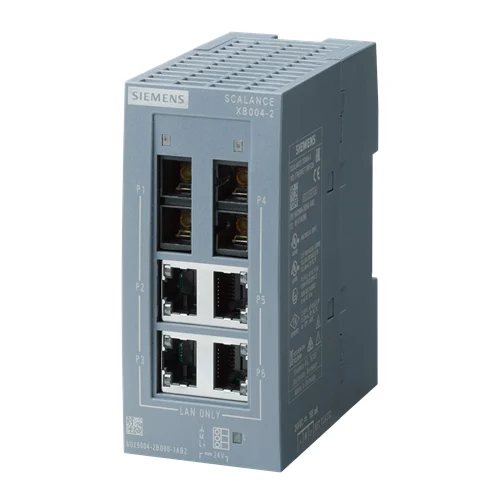
1. Small Production Line Networking
Connects various Ethernet-enabled sensors, actuators, and HMI panels within a compact production unit to a central controller or higher-level network, leveraging fiber optic ports for EMI-immune, long-distance links to other segments or control rooms.
Problem SolvedProvides reliable and flexible network connectivity in compact industrial production environments, overcoming limitations of copper cabling for longer runs and electrical noise via fiber optics.
Industrial EthernetPLC connectivityEMI immunityFiber opticsDistributed control24V DC
2. Building Automation Network Segmentation
Establishes reliable and segmented network connectivity for HVAC controls, access control systems, or IP cameras within a building, utilizing copper ports for local devices and multimode fiber to extend the network backbone across different floors or wings.
Problem SolvedEnables efficient and physically isolated network segmentation within building automation systems, ensuring robust data transmission over distances while providing electrical isolation between building sections.
Building Management Systems (BMS)IP video surveillanceAccess controlNetwork segmentationFiber backboneIP20
3. Water Treatment Plant Remote Monitoring
Connects remote monitoring units (e.g., pump stations, sensor arrays) in a water treatment facility back to a central control room, using fiber optic links to span long distances between dispersed areas and copper for local equipment.
Problem SolvedFacilitates reliable data transmission over extended distances and in varying environmental conditions for geographically dispersed assets in critical infrastructure, using fiber optics to mitigate signal loss and ensure continuous operation.
Remote monitoringSCADATelemetryProcess controlFiber optic communicationDistributed I/O-10 to +60 °C