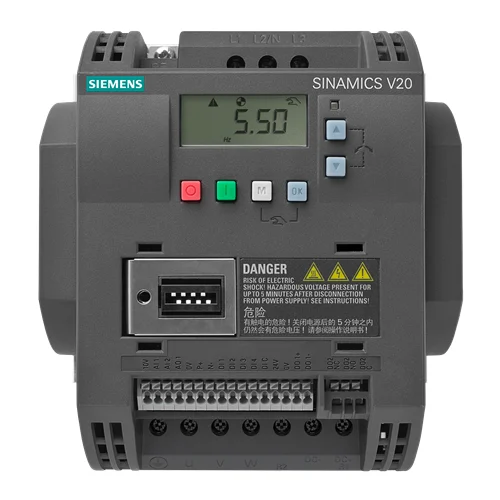
1. Conveyor Systems with Intermittent Heavy Loads
This inverter is suitable for driving conveyor belts that experience intermittent heavy loads, such as those found in packaging lines or material handling in manufacturing plants.
Problem SolvedThe 0.75 kW rated power is sufficient for typical conveyor speeds, while the 150% overload capacity for 60 seconds allows the drive to handle temporary increases in load (e.g., during start-up or when a large item is loaded) without tripping or requiring a larger, more expensive drive. Its compact size (9.0 cm x 15.0 cm x 14.55 cm) and IP20 rating make it suitable for installation within control cabinets in industrial environments.
Conveyor beltmaterial handlingintermittent loadoverload capacityIP20motor control
2. HVAC Systems for Fan and Pump Control
Ideal for controlling fans and pumps in Heating, Ventilation, and Air Conditioning (HVAC) systems in commercial buildings or light industrial settings, enabling precise air and fluid flow management.
Problem SolvedThe 380-480V 3-phase input and 0.75 kW output power are common requirements for smaller to medium-sized HVAC fan and pump motors. The ability to control output frequency from 0-550 Hz allows for precise speed control, leading to significant energy savings and improved system efficiency. Its IP20 rating ensures it can be safely housed in a controlled environment like an electrical room.
HVACfan controlpump controlvariable speed driveenergy efficiencyfrequency controlIP20
3. Textile Machine Speed Regulation
Can be used to precisely regulate the speed of motors in various textile machinery, such as spinning frames or weaving looms, where consistent and adjustable speed control is crucial for product quality and machine efficiency.
Problem SolvedThe 3-phase 380-480V input and 0.75 kW power are suitable for many small to medium-sized textile machine motors. The 0-550 Hz output frequency control enables fine-tuning of machine operation, which is critical for consistent tension and material handling in textile processes. The USS/Modbus RTU communication allows for seamless integration into a broader industrial control system, enabling centralized monitoring and adjustments.
Textile machineryspeed regulationmotor controlfrequency inverterModbus RTUprocess control