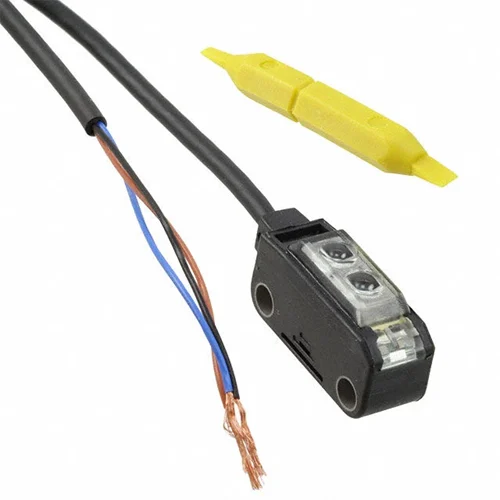
1. Precision Component Verification in Miniature Robotics
The EX-26A-PN can accurately detect the presence or absence of small, intricate components (e.g., small screws, pins, or electronic parts) on a rapidly moving conveyor or robotic gripper. Its compact dimensions (2.5 cm length, 1.23 cm width, 0.82 cm height), 0.1mm detectable object size, and 0.5ms response time enable precise and high-speed verification in extremely tight spaces.
Problem SolvedEnsures correct component placement and prevents assembly errors in highly automated and miniaturized manufacturing processes where space is extremely limited and speed is crucial.
Micro-assemblyobject detectionminiaturizationautomated manufacturing0.1mm detectable0.5ms responsecompact sensor
2. Web Edge Guiding in Film and Paper Processing
This sensor is suitable for precisely detecting the edge of thin materials like film, paper, or textiles to maintain accurate alignment during winding, cutting, or printing processes. The 0.05 mm repeatability and small spot beam are critical for maintaining tight tolerances, while its IP67 rating provides protection against dust or splashes common in these environments.
Problem SolvedPrevents material wastage and ensures product quality by providing highly repeatable and accurate edge detection for guiding systems, even in challenging industrial conditions.
Web guidingedge detectionmaterial alignmentfilm processingpaper converting0.05mm repeatabilityIP67
3. Tool Presence and Position Confirmation in CNC Machines
Integrated into a CNC machining center, the EX-26A-PN can verify the presence and correct seating of small cutting tools or workpieces in jigs, even in environments with cutting fluids or dust. Its IP67 rating ensures durability against coolants and chips, while the short 6-14mm sensing range and small spot are ideal for confirming discrete positions within the machine's work envelope.
Problem SolvedMinimizes costly machining errors and ensures operational safety by confirming tool changes or workpiece clamping before operations begin, contributing to higher precision and reduced downtime.
CNC machiningtool verificationworkpiece detectionindustrial automationIP67position sensing