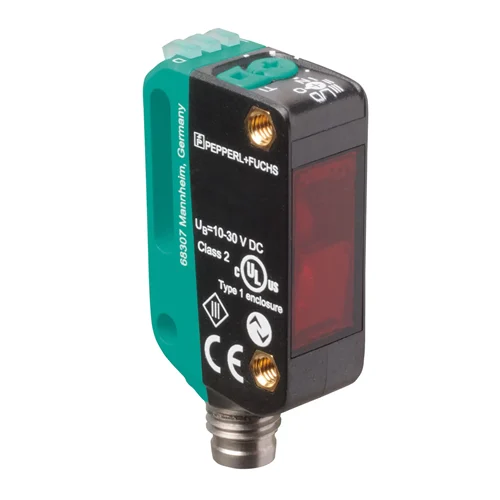
1. Clear Glass Bottle Detection on Beverage Conveyors
In food and beverage bottling plants, automated lines must count and track clear glass bottles. Standard optical sensors often fail to detect them because light passes through the glass.
Problem SolvedThe polarization filter and low-contrast sensitivity settings allow reliable detection of highly transparent objects (down to 18% contrast for glass) up to 3.5m away, preventing false counts and ensuring conveyor flow.
clear glass detectionpolarization filterlow contrast sensingbottling conveyor
2. IP69K Washdown Food Processing Lines
Food packaging environments demand strict sanitation and daily high-pressure washdowns, which cause typical proximity and photoelectric sensors to fail due to water ingress.
Problem SolvedThe IP69K-rated polycarbonate and PMMA housing prevents moisture ingress even under 100-bar high-temperature washdowns. IO-Link enables real-time diagnostic reporting to detect clean-in-place issues.
IP69K washdownfood packaging machineryhygienic sensorpolycarbonate housing
3. PET Film Web-Break Detection in Converting Machinery
High-speed continuous roll feeding of thin, highly transparent PET or plastic films requires immediate roll failure detection. A web break can cause material pile-ups or machinery damage if not stopped instantly.
Problem SolvedConfiguring the sensor's contrast threshold (down to 10%) permits continuous tracking of the clear film. Its 500 Hz switching frequency triggers a system-wide emergency stop the instant a web break occurs.
web break detectiontransparent film sensingconverting machineryhigh-speed switching