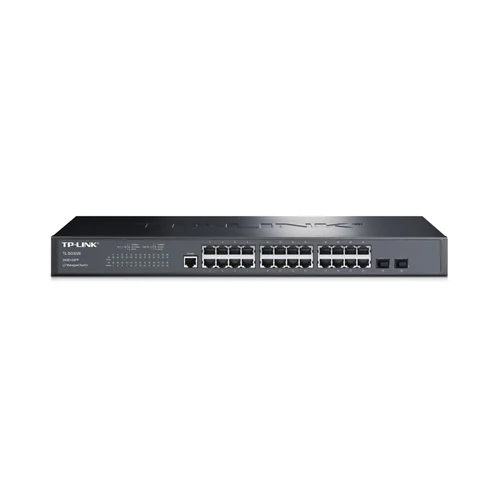
TP-Link TL-SG3226 Gigabit L2 Managed Switch

USD 299.50

L2 managed switch with 24 Gigabit RJ45 ports and 2 SFP slots, featuring IP-MAC-Port-VID security binding, rich QoS scheduling, and cloud-based management.

SKU TP-Link-TL-SG3226 Category
Top Brands > TP Link > TP-Link Managed Switches

TP-Link TL-SG3226 Gigabit L2 Managed Switch

Model Identifier TL-SG3226
Official Part Number TL-SG3226
GTIN Standard NA

Technical Overview

L2 managed switch with 24 Gigabit RJ45 ports and 2 SFP slots, featuring IP-MAC-Port-VID security binding, rich QoS scheduling, and cloud-based management.

Key Features

  • 24 x 10/100/1000Base-T RJ45 auto-negotiation ports for high-density copper links [3.2.3]
  • 2 x independent Gigabit SFP optical slots for flexible long-distance fiber uplink configurations
  • Comprehensive IP-MAC-Port-VID binding, ARP defense, IP Source Guard, and DoS protection
  • 802.1Q VLAN, Voice VLAN, and Multicast VLAN support for network segment isolation
  • Robust QoS traffic shaping with Equ, SP, WRR, and SP+WRR queue scheduling algorithms
  • IGMP v1/v2/v3 Snooping and Multicast Filtering to optimize multicast video streaming and bandwidth
  • STP/RSTP/MSTP spanning tree protocols and dynamic link aggregation (LACP) for loop prevention and link redundancy
  • Multi-mode management suite: Web GUI, command-line interface (CLI) via Telnet/SSH, SNMP (v1/v2/v3), and remote cloud utility

100–240 V AC, 50/60 Hz internal power supply with 15W maximum power consumption and 4W static power consumption.

Technical Specification Matrix

ParameterValue
Port Configuration24x 10/100/1000Mbps RJ45 ports, 2x 1000Mbps SFP slots, 1x Console port [3.2.3]
Switching Capacity56 Gbps
MAC Address Table Size8K entries
Input Voltage Range100-240V AC, 50/60Hz
Maximum Power Consumption15 W
Static Power Consumption4 W
VLAN SupportIEEE 802.1Q VLAN, Voice VLAN, Multicast VLAN
Spanning Tree ProtocolsSTP (IEEE 802.1d), RSTP (IEEE 802.1w), MSTP (IEEE 802.1s)
Reliability & RedundancyLoop protection, Root bridge protection, BPDU filtering, LACP Link Aggregation
Multicast ManagementIGMP v1/v2/v3 Snooping, Multicast Filtering, Multicast VLAN
Network SecurityIP-MAC-Port-VID Binding, ARP Defense, IP Source Guard, DoS Guard, 802.1X Authentication
Operating Temperature0°C to 40°C (32°F to 104°F)
Operating Humidity10% to 90% RH, non-condensing
Mounting Options19-inch standard rack-mountable, 1U height
Physical Weight (kg)2.18
Dimensions L x W x H (cm)18 x 44 x 4.4

Industrial Applications

1. Industrial PLC and HMI Automation Network Integration

Integration of factory floor Programmable Logic Controllers (PLCs), Human-Machine Interfaces (HMIs), and visual sensors onto a robust Ethernet backbone. Spanning Tree Protocols (STP/RSTP/MSTP) in the TL-SG3226 eliminate Layer 2 loops that can interrupt industrial control traffic, maintaining steady telemetry pathways [2.1.1].

Problem Solved

Network loops formed by accidental cable redundancy on busy industrial floors can cripple PLC-to-HMI communications, causing plant downtime. Spanning Tree Protocol actively detects and blocks redundant loops, restoring communication paths instantly in a failure event.

STPRSTPPLC NetworkingLoop ProtectionLACP

2. SCADA Network Segmentation and Plant Security Protection

Secure partitioning of administrative, control room, and manufacturing equipment segments on the same physical floor. Utilizing IEEE 802.1Q VLANs and advanced Layer 2 to Layer 4 Access Control Lists (ACLs) prevents unauthorized administrative devices from crossing into SCADA network boundaries.

Problem Solved

Direct exposure of industrial control systems (ICS) to standard office networks introduces cybersecurity vulnerabilities. The switch blocks non-authorized MACs, limits unauthorized cross-segment protocols, and deploys IP-MAC-Port-VID binding to guarantee only registered machines communicate with the SCADA servers.

802.1Q VLANAccess Control ListsIP-MAC-Port-VID BindingSCADA Network802.1X

3. Industrial Multicast IP Surveillance Network Backbone

Aggregating dozens of high-definition industrial IP cameras across large processing areas or warehouses, feeding data back to a centralized NVR server. The system leverages IGMP v1/v2/v3 Snooping and Multicast VLANs to precisely manage traffic routing.

Problem Solved

Unmanaged multicast video feeds from IP cameras flood every port on traditional network devices, quickly saturating bandwidth and causing video frame loss. IGMP Snooping ensures multicast packets are only forwarded to the exact ports hosting the NVR or monitors, keeping the remaining 24 ports completely congestion-free.

IGMP SnoopingMulticast VLANIP SurveillanceQoS Traffic Control

Select your currency