1. Campus-Wide Optical Aggregation
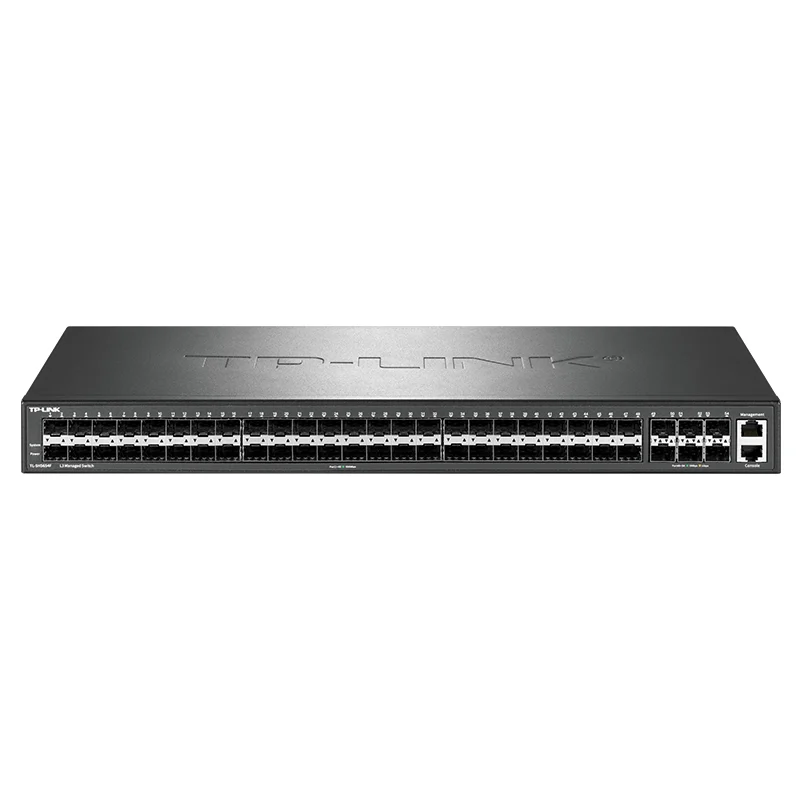
Standard industrial or academic campuses require a central aggregation layer that connects multiple scattered sub-buildings or shop floors over long distances where copper cabling is limited. The 48 Gigabit SFP optical slots allow direct, noise-immune single-mode or multi-mode fiber runs from remote edge switches, avoiding electromagnetic interference in factory-adjacent environments.
Problem SolvedBypasses the 100m copper limit and industrial EMI issues by aggregating 48 separate fiber optic links back to the core network over long distances.
Fiber-Optic AggregationSFP PortsLayer 3 AggregationEMI ImmunityGigabit SFP
2. Distributed Industrial Video Surveillance Network Aggregation
High-definition surveillance in sprawling industrial yards or mines generates massive bandwidth demand. The TL-SH5654F utilizes its 6 10-Gigabit SFP+ uplink ports to deliver non-blocking 10G high-bandwidth backbone transmission to central storage servers, while its 48 Gigabit SFP ports interface directly with fiber-optic field transceivers connecting high-resolution IP cameras across wide spatial footprints.
Problem SolvedResolves bandwidth bottlenecks and frame drops by aggregating high-definition IP camera traffic over a 10G non-blocking backbone.
10G UplinkNon-Blocking Line RateIGMP SnoopingVideo AggregationSFP+ Slots
3. Multi-Subnet Segmented Process Control Networks
In automated facilities, separating administrative traffic from critical real-time SCADA or process control networks is essential for safety and performance. This Layer 3 switch implements RIP dynamic routing and static routing alongside private VLAN structures to isolate traffic subnets directly at the aggregation layer, allowing controlled, hardware-accelerated inter-VLAN routing without relying on a bottlenecked external router.
Problem SolvedEliminates security exposure and router bottlenecks by hosting high-speed inter-VLAN routing and subnet isolation on-device.
Layer 3 RoutingRIPVLAN SegmentationACL SecurityInter-VLAN Routing