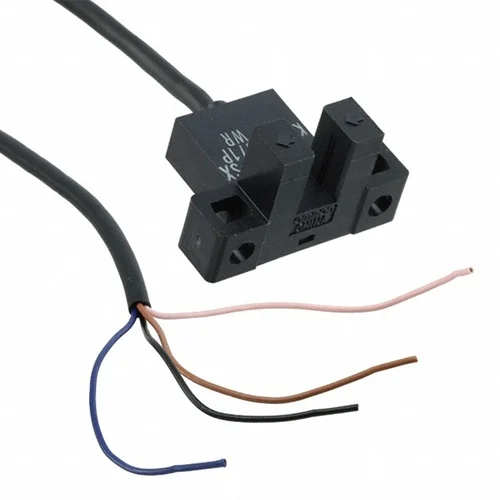
1. Robotic Arm End-Effector Positioning
Utilizing the sensor on the moving wrist or gripper of an automated robotic arm to confirm when an opaque component has correctly seated within the jaws prior to clamping.
Problem SolvedStandard sensor cables quickly fail and break under the continuous flexing and twisting of multi-axis robotic movements. The built-in 1-meter robotic cable directly mitigates mechanical stress failure, drastically reducing maintenance downtime.
Robotic Cable FlexingEnd-Effector PositioningThrough-beam Slot SensorPNP Open Collector
2. High-Speed Rotary Indexing Table Synchronization
Detecting indexing flags or tabs on the perimeter of a fast-moving rotary table in packaging lines to send a precise trigger signal to the PLC for the next automated sequence.
Problem SolvedStandard limit switches or slow sensors cause timing delays in fast rotary applications, leading to misaligned packaging strokes. The minimum 1 kHz response frequency ensures virtually instantaneous trigger signals at high RPMs.
1 kHz Response FrequencyRotary IndexerOpaque Object DetectionHigh-Speed PLC Triggering
3. Automated Substrate Tray Verification
Mounting the L-shaped sensor along the rail of a conveyor system to accurately detect the leading edge of opaque substrate trays or cassettes entering a processing module.
Problem SolvedInconsistent ambient lighting can cause diffuse photoelectric sensors to misread tray edges, resulting in machine crashes. The 5mm slot through-beam design, combined with the 940nm infrared light source, ensures precise, fail-proof edge detection regardless of environmental lighting (up to 1000 lx fluorescent interference).
Substrate Cassette DetectionL-shaped Photomicro sensorInfrared 940nmAmbient Light Immunity