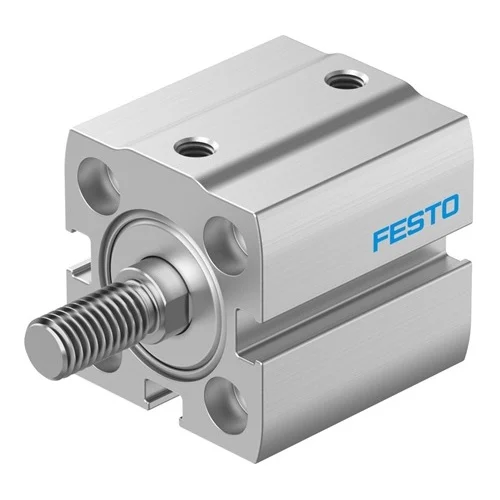
1. High-Density Smartphone Button Endurance Testing Jig
An automated quality assurance test rig designed to repeatedly actuate mobile device buttons millions of times to evaluate mechanical lifecycle and failure rates. Multiple compact cylinders are mounted closely side-by-side in a confined test fixture to simulate user inputs simultaneously.
Problem SolvedStandard pneumatic cylinders are too bulky for high-density, multi-button testing on small electronics. The ultra-compact dimensions and 15 mm short stroke allow for tight spatial integration, while built-in position detection via proximity switch ensures accurate stroke cycle counting for reliability data.
15 mm StrokePosition detection Via proximity switchDouble-actingElastic cushioning rings/plates at both endsM5 Pneumatic connection
2. Cleanroom Semiconductor Wafer Clamping Mechanism
A precision holding module inside a semiconductor fabrication line that uses controlled pneumatic actuation to gently push and secure delicate silicon wafers or electronic substrate carriers during processing, coating, or inspection stages.
Problem SolvedSemiconductor manufacturing strictly prohibits particulate contamination, and delicate substrates are easily shattered by hard impacts. The cylinder solves these issues by meeting Class 5 ISO 14644-1 cleanroom standards to prevent outgassing or particle generation, while its elastic cushioning absorbs kinetic energy (0.2 J limit) to prevent wafer damage.
Cleanroom suitability Class 5 according to ISO 14644-10.06 MPa ... 1 MPa Operating pressureMale thread Piston-rod endImpact energy in end positions 0.2 JAnodised wrought aluminium alloy
3. Robotic End-Effector for Lithium-Ion Battery Cell Insertion
A high-speed automated robotic cell insertion station where the pneumatic cylinder is integrated directly into a robotic arm. It acts as a pusher unit to precisely drive individual lithium-ion battery cells into module carrier trays during EV battery pack assembly.
Problem SolvedEnd-of-arm tooling requires minimal weight to prevent robotic inertia issues, yet needs high pushing force to seat heavy battery cells. The cylinder's ultra-low base weight (65 g) reduces arm payload, while the 20 mm piston generates a strong 188 N advance force at 6 bar to reliably position the cells in a fast-paced environment.
Theoretical force at 0.6 MPa (6 bar, 87 psi), advance stroke 188 NHigh-alloy stainless steel piston rodVDMA24364-B2-L LABS (PWIS) conformityBasic weight for 0 mm stroke 65 gPiston diameter 20 mm