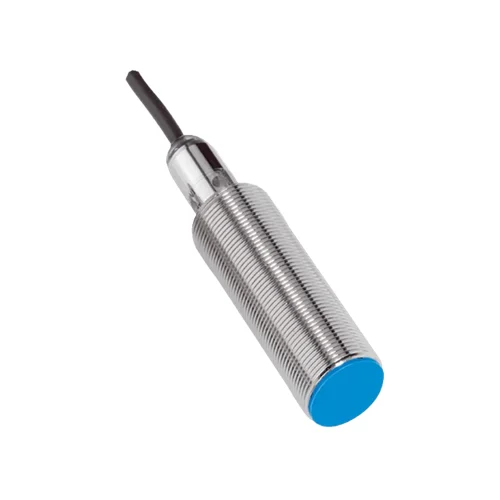
SICK 1067897 IME18-08BPPZWDSS21 PNP Inductive Proximity Sensor

USD 76.44

8 mm nominal inductive sensing, complementary PNP output, IP67 housing, 10–30 V DC and 15 m four-wire PVC cable with 0.25 mm² conductors.

SKU SICK-1067897 Category
SICK IME

SICK IME18-08BPPZWDSS21 PNP Inductive Proximity Sensor

BrandSICK
Model IdentifierIME18-08BPPZWDSS21
Official Part Number1067897

Technical Overview

The SICK IME18-08BPPZWDSS21 is a standard-length M18 × 1 inductive proximity sensor for flush installation. Nominal sensing range is 8 mm and assured range is 6.48 mm, with material-dependent reduction factors for non-reference metal targets. Its complementary PNP output supports 1,000 Hz switching and connects through a 15 m four-wire PVC cable with 0.25 mm² conductors. The nickel-plated brass housing and PA 66 sensing face provide IP67 protection, while two nickel-plated brass mounting nuts establish threaded attachment. Operation uses 10–30 V DC and spans −25 to +75 °C. Short-circuit and power-up pulse protection accompany a local indication LED, with housing length 67 mm and maximum tightening torque 40 Nm.

M18 × 1 flush inductive sensor with 8 mm nominal range, complementary PNP output, 1,000 Hz switching and 15 m four-wire PVC cable.

Key Features

  • M18 × 1 standard-length cylindrical housing; flush installation
  • 8 mm nominal sensing range; 6.48 mm assured sensing range
  • Complementary PNP output; 1,000 Hz switching
  • 15 m four-wire PVC cable; 0.25 mm² conductors; Ø3.9 mm
  • 10–30 V DC; ≤200 mA continuous output current; ≤10 mA no-load current
  • ≤100 ms startup availability delay; 5–15% hysteresis
  • Short-circuit and power-up pulse protection
  • Nickel-plated brass housing; PA 66 face; IP67
  • Two nickel-plated brass nuts, 24 mm across flats; maximum tightening torque 40 Nm
  • −25 to +75 °C operation; 67 mm housing and 52 mm thread

Detect a metal target through an 8 mm nominal inductive field and supply complementary PNP states to external machine sequencing or counting electronics.

Technical Specification Matrix

ParameterValue
Functional principleInductive proximity sensing of metal targets
Housing designCylindrical standard-length metric threaded housing
Mounting threadM18 × 1
Diameter18 mm
InstallationFlush
Nominal sensing range Sn8 mm
Assured sensing range Sa6.48 mm
Switching outputComplementary PNP
Electrical wiringDC four-wire
Switching frequency1,000 Hz
Connection15 m four-wire PVC cable
Conductor cross-section0.25 mm²
Cable diameter3.9 mm
Conductor functionsCD-005: BN=L+; BK=NO; WH=NC; BU=M
Power supply10–30 V DC
Ripple≤10%
Voltage drop≤2 V at maximum output current
Continuous output current≤200 mA
No-load current≤10 mA
Availability delay≤100 ms
Hysteresis5–15%
Reproducibility≤2% of Sr at constant supply voltage and ambient temperature
Temperature drift±10% of Sr
ProtectionShort-circuit protection; power-up pulse protection
EMCEN 60947-5-2
Shock resistance30 g, 11 ms
Vibration resistance10–55 Hz, 1 mm amplitude
Operating temperature−25 to +75 °C
Housing materialNickel-plated brass
Sensing face materialPA 66 plastic
Housing length67 mm
Thread length52 mm
Maximum tightening torque40 Nm
Items suppliedTwo nickel-plated brass mounting nuts, 24 mm across flats
IndicationLocal LED
IP ratingIP67; EN 60529
UL fileNRKH.E181493
Material reduction factorsVariable reference values: St37 steel 1; V2A/304 stainless approximately 0.8; aluminum approximately 0.45; copper approximately 0.4; brass approximately 0.4
Installation clearancesB=36 mm; C=18 mm; D=24 mm; F=64 mm, per flush-installation graphic

Industrial Applications

1. Confirming a metal slide at a machine end position

A machine slide can present a metal flag to the flush sensing face and feed the complementary PNP state into external sequencing logic. The controller evaluates that state after the slide settles at its expected stop. Installation establishes target material and gap using the 8 mm nominal and 6.48 mm assured ranges, including the documented reduction factors and mounting clearances.

Problem Solved

An inductive target state gives external sequencing a slide-position reference, helping identify whether the metal flag has reached the intended machine end location.

Slide position Flush Metal flag

2. Counting metal features on a rotating machine shaft

A rotating assembly can pass separated metal features through the inductive field and send output transitions to an external pulse counter. The 1,000 Hz switching rating provides a frequency limit for the planned feature rate. Mechanical setup controls runout, target coverage and the sensing gap, while external evaluation converts counted events using the known number of features per revolution.

Problem Solved

Repeated inductive transitions give external counting electronics a rotation reference, helping track shaft movement from known metal features without contact at the sensing location.

Rotation events 1,000 Hz External counter

3. Monitoring metal material at a feeder threshold

A parts feeder can position the sensor beside a selected threshold where metal components normally occupy the sensing field. External logic times the complementary PNP condition to distinguish a brief gap from sustained material absence and request replenishment. Commissioning uses the actual metal’s reduction factor, the flush installation clearances and the documented operating-temperature range.

Problem Solved

A persistent inductive-state change gives external feeder monitoring a material-presence reference, helping request replenishment when metal components remain absent from the selected threshold.

Feeder threshold Metal material External timer

Select your currency